This post is first and foremost an invitation and appeal for collaboration. It’s early, raw, and missing lots of pieces. But if any of it begins to scratch an itch, please reach out!
It’s been bothering me for a while that we (the Left) see ourselves as working on a series of intersectional, connected issues vs. a single, central, and connecting issue: Capitalism. Worse, I believe our opponents–exemplified by the Silicon Valley billionaire cabal–understand and advance their goals within a singular, cohesive, and integrated frame, which means we’re working at a perpetual disadvantage.
As a result, I’ve painted myself into a demoralizing corner. I have a hard time getting energized about progressive causes as currently scoped and defined. (With the possible exception of Labor, due to its fundamental and cross-cutting power.) Why address a symptom when you can address the cause? Especially when the cause is so fucking obvious?
Until recently, the main obstacle has been cultural. When I was 19, if you were to say “…well, clearly the problem is capitalism,” serious adults would pat you on the head and send you back to your dorm room. Now, anyone under 35 looks at you and says “Yes, clearly. And…?” There has been a distinct shift in the zeitgeist. Specifically, you’re now permitted to examine and critique capitalism as a singular construct and be taken seriously. The myriad and compounding crises we face means folks are willing to–desire and want to–examine our challenges at a global, systemic level. “There is no alternative” is no longer gospel. We can see the forest for the trees.
Cory Doctorow has written that, counter to the meme, it’s easy to imagine alternatives to capitalism. That, as a science fiction author, he does it every day. The hard part is envisioning how to bring it about. The actual transition. But there are two, parallel realizations that suggest where to begin.
The first is recognizing that we’ve done it before, replaced systems wholesale:
“We live in capitalism. Its power seems inescapable. So did the divine right of kings. Any human power can be resisted and changed by human beings.”
― Ursula K. Le Guin
The second is a matter of giving yourself permission. A lot of large-scale human endeavor becomes possible when you just, simply, start to think and act at scale. My first experience of this was when I joined Mozilla. Up to that point, my work had been focused on my individual applications of the Web. Mozilla was full of folks–brilliant, but not superhuman–whose work decided what the entire World Wide Web could do. They established a posture where they could think and act at scale.
Enter the challenges. First, I’m not an academic. I’m at a disadvantage in assembling the prior thinking, work, and lessons learned that’s been done on this front. Second, something this ambitious requires a large, focused, and dedicated team. Finally, the work of ending Capitalism can’t be done by a few people; it has to be grounded in the values, communities, and practices we want to implement in its place.
But I’ve begun to play with a starting point: a work-in-progress map that shows all the issues we face within a singular lens.
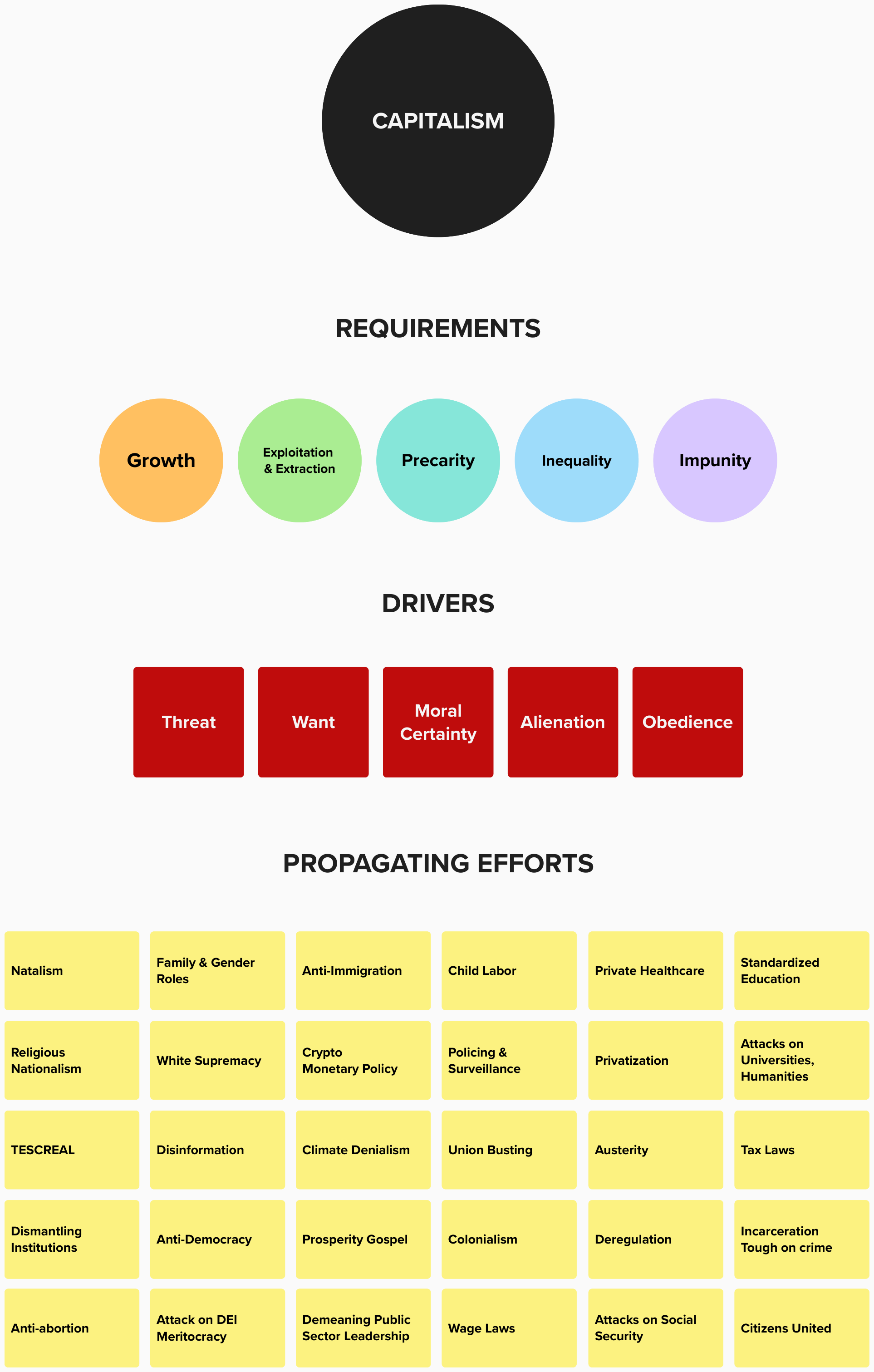
I’m exploring how this map might serve as the seed of a Grand Coalition, which, as with all good things, would begin as gathering of like-minded activists. Ideally over food.
Related Reading:
- “Capitalism: A Ghost Story” by Arundhati Roy – Roy explores the dark side of democracy in India, focusing on how corporate power and capitalism influence and exacerbate social and environmental issues.
- “Capitalist Realism: Is There No Alternative?” by Mark Fisher – Fisher argues that many contemporary problems, such as mental health issues, environmental crises, and social inequality, are deeply rooted in the pervasive influence of neoliberal capitalism.
- “The Shock Doctrine: The Rise of Disaster Capitalism” by Naomi Klein – Klein examines how capitalist policies exploit crises to push through controversial policies that often worsen social and economic inequality.
- “This Changes Everything: Capitalism vs. The Climate” by Naomi Klein – Klein argues that the climate crisis is a direct result of capitalism’s relentless pursuit of profit and growth, which is incompatible with the sustainability of the planet.
- “The Communist Manifesto” by Karl Marx and Friedrich Engels – Although not a contemporary work, it provides a foundational critique of capitalism, arguing that many societal problems are inherent to the capitalist system.
- “The Age of Surveillance Capitalism: The Fight for a Human Future at the New Frontier of Power” by Shoshana Zuboff – Zuboff discusses how modern capitalist practices, especially those in the tech industry, lead to unprecedented levels of surveillance and control, posing new social and ethical challenges.
- “Winners Take All: The Elite Charade of Changing the World” by Anand Giridharadas – Giridharadas critiques how elite-driven philanthropy and social initiatives often reinforce the capitalist systems that cause many of the problems they aim to solve.
- New Consensus: Mission for America – Zack Exley’s ambitious follow-up to the Green New Deal, which calls for grand, public works.
- “The Entrepreneurial State” by Mariana Mazzucato – Mazzucato argues that the state plays a crucial and often underappreciated role in driving innovation and economic growth, challenging the myth that the private sector alone is responsible for technological advancements.
- “The Hammer: Power, Inequality, and the Struggle for the Soul of Labor” by Hamilton Nolan – Explores the singular potential of the Labor movement as a force for progressive reform.
The exercise continues in the next post: End what, exactly?
 Geoffrey MacDougall
1 comment