Testimonials
-
Rebecca Lendl, Long Now Foundation
Hands down my favorite renegade fundraiser! Geoffrey is absolute best in class at all the standard fundraising challenges — building a strong campaign, cultivating real relationships with donors, making asks, and deepening donor engagement. But even beyond that, he brings a truly sophisticated understanding of money and power, and how to work with these dynamic… con’t
Bio
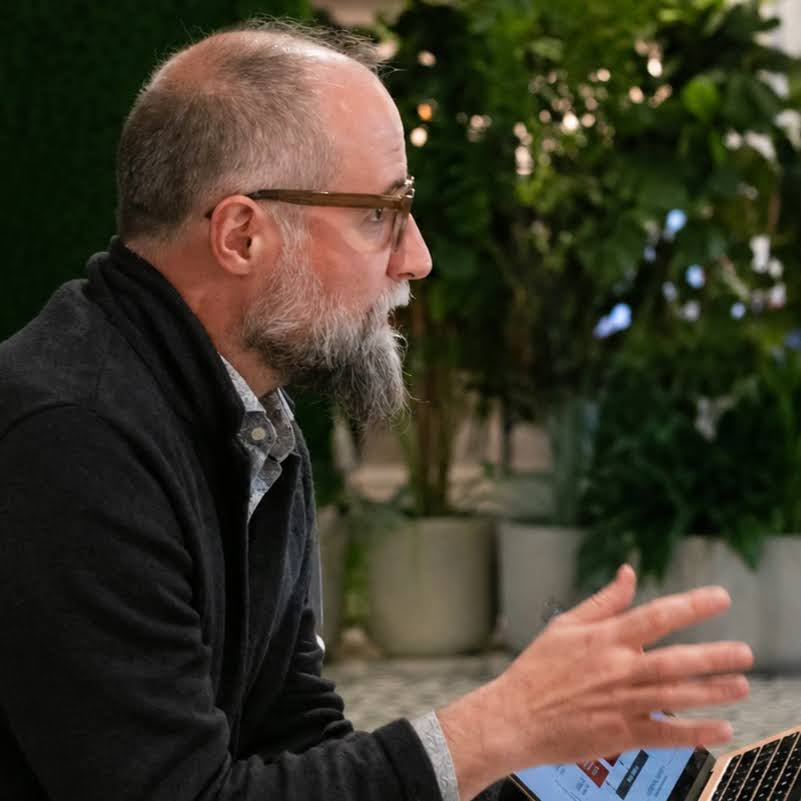
Geoffrey MacDougall is an accomplished nonprofit executive and fundraiser, with a track record of securing transformative investment for mission-driven organizations. As Vice President at Consumer Reports and Mozilla, he spearheaded initiatives that advanced privacy, digital rights, and antitrust initiatives while driving significant philanthropic growth.
Over his career, Geoffrey has directly raised more than $100 million and guided others in raising hundreds of millions more. Now a Senior Advisor at Aspiration, he helps emerging nonprofit executives secure vital funding and scale their impact, drawing on years of experience to redirect wealth toward transformative social change and equity-driven outcomes.
A design enthusiast, Geoffrey divides his time between Manhattan and Roxbury, NY, where he and his family have restored a 19th-century farmhouse. An avid expedition canoeist and trip leader with the Appalachian Mountain Club, he enjoys exploring the backcountry and perfecting his collection of gear.
Story of Self
The following account is accurate. Even when it isn’t strictly true.
I grew up in a union household on the Canadian prairie, the son of an early tech entrepreneur/math teacher and second-wave feminist social worker. I was raised in the grand traditions of prairie populism, social democracy, and Toronto-the-Good WASP-ishness (my parents’ hometown). I’m never more at home than in the throng of a protest march.
In elementary school, my friends and I helped pioneer BBS culture in western Canada. I learned Logo and Basic, transcribing lines of code into my CoCo II so I could play early adventure games.
In high school, I was kicked out of computer science for hacking into the school’s network. (It wasn’t hard.) Blocked from machines, I discovered my true calling during a social studies debate class: a life-long fascination with power, political ideology, and rhetoric. I abandoned the ones-and-zeroes of tech for the shades-of-gray of humans. I also became cursed as a generalist, winning the ‘General Proficiency’ award for the highest mix of academic, social, and athletic achievements.
I received a full scholarship to study International Relations in Toronto–the Canadian version of moving from Omaha to Manhattan–where I was a few years younger than my classmates. I promptly lost my scholarship when I began to devote all my time to activism, helping to organize the largest student protests in Canadian history (mostly as a kid along for the ride). I ran for the student union and lost. I competed in national and North American model UNs and won. I took a summer job as a waiter and helped unionize the place under the SEIU (mostly as a kid along for the ride).
I took a year off to do development work in southern India. Before I left, I met my wife at a rave club. In India, I surveyed the household economics of 200 subsistence-level farm families; the resulting data underpinned a funding proposal to the World Bank. My wife and I wrote each other letters every day. I sent her a telegram in Normandy on her birthday. We moved in together when I returned for school. It’s been 30 years.
I met my dear friend and future business partner playing pool. His older brother, a classmate, ditched him on me during a weekend visit as we were both too young to go drinking. Under the wing of an early mentor, we ran the United Nations World Summit of Young Entrepreneurs during the launch phase of the dot-com boom. I co-wrote a speech for Boutros-Ghali. With the help of another dear friend, we cobbled together what was likely the world’s first virtual UN event in a repurposed MUD client. It was profiled in Wired.
One of those entrepreneurs gave us our first start-up funding. We matched it with government money (the first ever invested in a video game), dropped out of university, and launched an effort to build a MMORPG, sell virtual goods in-game, and serve 3D graphics through a browser. In 1998, which turned out to be a decade too early. We pitched Microsoft. They laughed at the idea of giving $20M to 20yos. (Again, 1998.) We rallied and tried again, pitching NCSoft and Sony Online Entertainment. Sony offered us a term sheet, which we weren’t able to accept. But there are still relics of this era online. I’m a contributor to the Declaration of the Rights of Avatars. Look it up.
I found myself unemployed and nearly unemployable. No one knew what it meant to be a 20yo university drop-out with the intense and comprehensive experience of a start-up. The legend of Mark Zuckerberg didn’t exist, especially in Canada. I managed to talk my way into a job running a public/private partnership to get technology into nonprofits. I met a dear friend and collaborator. I raised more money and launched TechSoup in Canada, a program that’s channeled 100s of $Ms of free software to Canadian charities.
We tried an online games start-up one last time. We raised just under $1M from the government and an angel investor. We got close. Unity launched as we were wrapping our technology development. We chose to stick with our platform. We chose wrong. Ironically, my friend and business partner eventually became the head of product at Unity.
Once again, I found myself unemployed and without a clear profession. Only this time as a 30yo father. I explored a few consulting veins in vain. I had a wide range of experience but very few accolades. Except for one: I could, and can, persuade people to write cheques.
I rebranded as a fundraiser and joined a small firm. The head of the firm gave me countless valuable lessons in How. To. Fundraise. We had a former Premier twist the arms of real estate developers. We secured $5M to build a center for victims of domestic violence. We gave tours of the King of Abu Dhabi’s private jet to government Ministers. We secured $6M to retrain unemployed auto workers as in-demand aerospace workers. I could finally tell you what I did for a living.
I reconnected with the nonprofit tech friend at a party. He’d just taken the reins at Mozilla and needed to raise money. He offered me the chance to prove myself on a bigger, international stage. We turned a $25K/y program into a $15M/y program. We secured investments from all the major American foundations to protect privacy, help kids learn to wield the web as a weapon, and advocate for open values. We built a sophisticated advocacy program. We won national fights over copyright and net neutrality. We hired the wrong CEO and were–rightly–attacked by our peers. We regrouped and rebuilt our brand. I traveled the world and made life-long friends. I got my first taste of playing at scale.
A friend at the Ford Foundation convinced me to do it all again at Consumer Reports. Take a beautiful-but-aging anti-capitalist institution and reclaim its power and relevance. We sold our loft and emigrated to New York. We rebuilt a winning advocacy program. We created The Digital Standard to evaluate technology products for their impact on privacy, competition, and individual agency. We raised the largest investment in CR’s 80 year history, which was profiled in the NYT. We began to launch new products and services. We started to find new relevance.
I got my EB-1 green card. My family’s future in the US secure, I could work wherever, do whatever I wanted. What I wanted was a break.
We bought a 200yo, abandoned farmhouse in the Catskills a year before the pandemic. I spent every free moment and dollar on it for four years. We did most of the work ourselves. It was hard, especially in isolation. But the joy of completion washed those memories away. As a nice, bougie reward, our design and restoration effort was profiled in Dwell.
Working on the house helped me figure out what I wanted to do next. I wanted to work with smaller, dynamic, activist organizations trying to save us all from ourselves. I wanted to pick big fights. Swear in meetings. Be myself. Teach. Bond. Be part of community. Help folks find their swagger and gain the power and confidence that comes from knowing how to raise money.
Gunner thought that sounded pretty cool and gave me a seat at Aspiration. I’m very grateful. I’ve spent the last 10+ years in the back pockets of some of the most amazing and dynamic nonprofit leaders, executives, and activists out there. I’ve helped channel and redistribute 100s of $Ms of wealth to work that actually matters. Mostly around the impact of technology and digital rights. But also in open science, journalism, and education. Hoping to come full circle and work with labor, again, too.
Today, you can find me running workshops or supporting folks 1:1. I’m authoring a fundraising textbook and have launched a podcast where we interview funders on how fundraising actually works. And canoeing. A lot. I’m Canadian, after all.